Archival Imaging for Artworks: Building a Record That Lasts
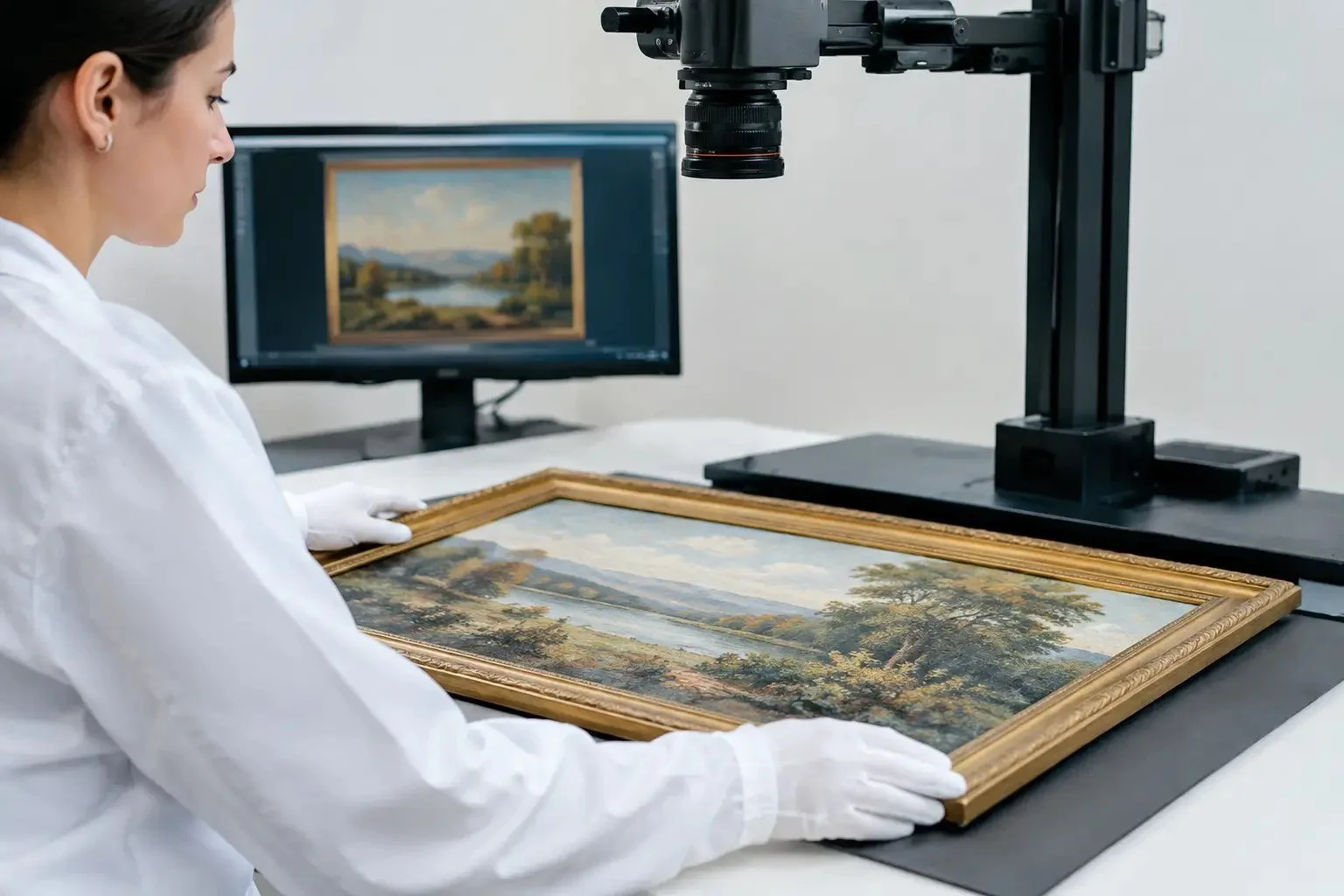
A painting may leave the studio, enter a collection, travel to an exhibition and appear in print long before anyone revisits its condition or ownership. Archival imaging for artworks creates the visual record that follows it through each of those moments. When the image is faithful, it preserves evidence of the artist's decisions: colour relationships, surface character, scale, edge and tonal structure.
This is not ordinary photography with a bigger camera. An archival image must stay useful when it is viewed closely, reproduced at different sizes, compared with the original years later, or supplied to a curator, insurer, publisher, conservator or collector. For artists, galleries and collections in Malaysia, that standard calls for a controlled process at every stage.
What archival imaging for artworks must preserve
Colour. A slightly warm white balance can turn a cool grey yellow. Faithful colour needs calibrated capture, controlled lighting, accurate profiling and a reliable monitor. Correction by eye alone can look right on one screen and wrong everywhere else.
Tone. Deep blacks should keep their internal structure, and pale passages need enough separation to show form without added contrast.
Surface. Varnish, impasto, metallic pigment, wax, graphite and watercolour paper all respond differently to light. No single lighting arrangement serves every work.
The conditions behind a trustworthy capture
The camera is only one part of the system. Before photography begins, assess the artwork: is the support flat, does the surface reflect, are there raised elements, deckled edges or a frame that needs separate documentation?
Even illumination is essential for most two-dimensional work, because uneven falloff changes the apparent value of a colour field from one side to the other. Reflections are managed through the position and size of the light source, camera angle and, where appropriate, cross-polarisation. Cross-polarisation reduces glare well, but it can also suppress sheen that genuinely belongs to a varnish or pigment, so the choice depends on what the record must show. The same principles that guide good gallery lighting apply at the capture stage.
Resolution is not the same as information
A large file that is poorly lit, soft, clipped in the highlights or inaccurate in colour simply preserves its errors in greater detail. The right resolution depends on the size of the original and its likely future uses, and the file should hold real image data rather than interpolated detail.
Check focus across the whole plane of the artwork and keep the geometry true, so edges stay straight and proportions are not altered by perspective. A useful archival package usually includes:
A high-resolution master file, kept without destructive compression or repeated resaving
Derivative files prepared for print and for digital use
Documentation that identifies the work accurately
Documentation extends beyond the image
At minimum, associate each file with:
Artist's name, title and date
Medium and dimensions
A consistent identifier or inventory number
Capture date, file version and rights information
Keep condition documentation separate. The principal image represents the work as a whole, while detail images record signatures, inscriptions, cracking, abrasion or handling marks for conservation and insurance purposes.
Where interpretation must stop
Removing dust introduced during capture is acceptable. Removing a stain, craquelure, uneven varnish or an edge irregularity that belongs to the object is not. The same restraint applies to colour and contrast: a promotional file may be adjusted for a specific print process, but it should never replace the preservation master.
When to reimage an artwork
After conservation treatment or substantial reframing
After a change in condition
Before a museum loan, a major publication or a new print edition
When the existing photographs no longer meet current standards
Older photographs remain useful as a record of a prior state, but they should not automatically be treated as the best current representation.
Frequently asked questions
What is archival imaging for artworks?
It is the controlled, colour-managed capture of an artwork to create a lasting master file that accurately records its colour, tone, detail and proportions, along with the information that identifies it.
What file should I keep as the archival master?
Keep a high-resolution, uncompressed or losslessly compressed master that is never overwritten. Make web, press and print versions as separate copies.
Does higher resolution always mean a better archive?
No. Lighting, focus, colour accuracy and geometry matter as much as pixel count. Resolution should match the size of the work and its intended uses.
Build your artwork archive with Nuray Lab
The best time to create an archival record is while the original is present and accessible. Nuray Lab provides high-resolution, colour-managed artwork reproduction in Malaysia for museums, galleries, artists, collectors and archives. To discuss a single work or a full collection, contact us.