Professional Painting Reproduction Photography: A Guide for Artists and Collectors
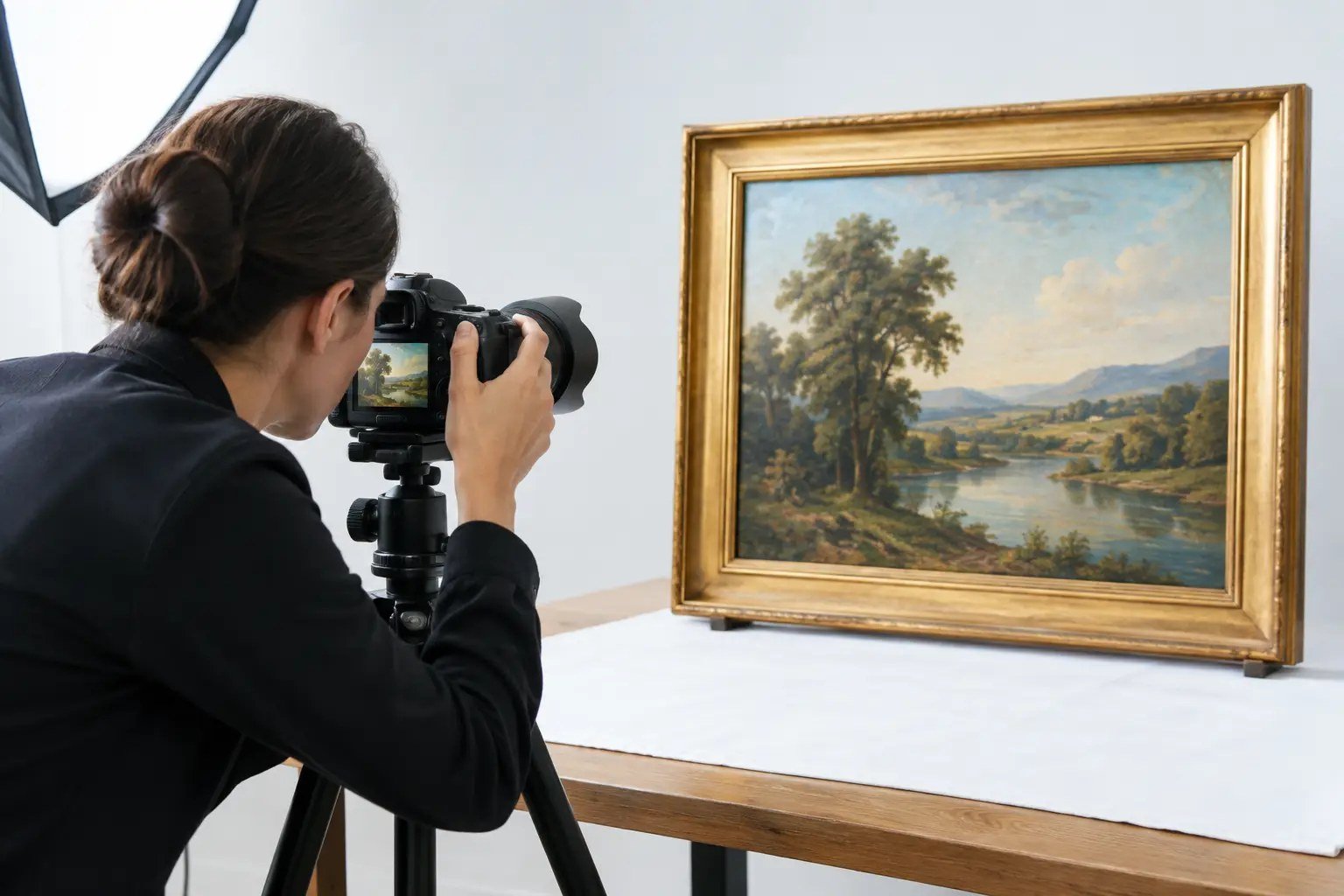
A painting can look entirely different when its deep blacks close up, a warm white shifts blue, or a quiet glaze disappears under flat light. Professional painting reproduction photography is the discipline of preventing those losses. For artists, galleries, museums and collectors in Malaysia, it creates a reliable record of the work with faithful colour, true proportions, visible surface character and controlled tonal range.
It is not simply a matter of using a high-resolution camera. A camera records the light it receives. If the painting is poorly lit, misaligned or processed without colour management, the file can be sharp and still be unfaithful to the artwork.
What professional painting reproduction photography protects
The purpose of a reproduction is not to make a painting look more dramatic than it does in person. It is to preserve the artist's visual decisions:
Colour fidelity. Pigments shift under different light sources, so neutral, high-quality lighting and calibrated capture are fundamental.
Tonal accuracy. Layered glazes, restrained palettes and dark fields lose depth when shadows are compressed or highlights are clipped.
Surface and texture. Brushwork, impasto, varnish and metallic leaf are part of the work's identity and may need their own detail images.
Proportion. A correctly aligned capture keeps the painting's shape and scale honest.
The conditions behind a faithful capture
Light must reveal without interfering
Even illumination from edge to edge is the foundation. Two balanced light sources at matching angles are a common starting point, but placement is adjusted for each work. Varnished oils, resin, encaustic and metallic pigments all need careful glare control, because glare hides colour and detail exactly where the image must be most trustworthy. Post-production can refine a well-captured file. It cannot restore information that poor lighting never recorded.
Alignment keeps proportions true
The camera sensor should sit parallel to the painting plane, with a focal length that avoids perspective and edge distortion. Larger works may call for a higher-resolution system or a stitched capture so that detail stays consistent across the whole surface.
Colour management turns a photograph into a record
A professional workflow uses calibrated equipment and reference targets to link the artwork, camera, monitor and final output. The capture is then compared with the original, and corrections are made with restraint. Over-sharpening, heavy contrast and boosted saturation may look striking on a phone screen, but they misrepresent the artist's palette and surface.
Plan the session around how the images will be used
Before a session, be clear about what the files must do. Typical uses include:
Portfolios, websites and juried show submissions
Catalogues, press and gallery sales material
Insurance and collection records
Archival masters for museums and private collections
Editioned fine art prints
The intended use decides the resolution, the need for detail images and the delivery format. It also decides whether the frame, edges, reverse, signature and labels should be documented. Keep one minimally altered master file, and create separate web, press and print versions from it rather than reusing a single compressed image for everything.
When one image is not enough
One frontal, colour-accurate image is essential, but it may not tell the whole story. Raking-light details show the hand of the artist and the depth of a layered surface. Installation views show how the work sits in a space. Each answers a different question, so keep them separate from the primary reproduction instead of trying to make one file do everything.
How to choose a painting reproduction photographer
Ask how colour is managed, from capture to proof.
Ask how reflective, varnished or textured surfaces are handled.
Confirm which files you will receive and at what resolution.
Explain the intended use, especially large-format printing or publication.
Check whether detail images, framed views and signature or verso documentation are included.
Frequently asked questions
What is painting reproduction photography?
It is the controlled photography of a painting to produce an accurate digital record of its colour, tone, detail and proportions, suitable for archives, publications and prints.
Why can't I photograph my painting with a phone or an ordinary camera?
You can for casual sharing. For print, publication, insurance or archive use, uneven light, glare, lens distortion and unmanaged colour usually make the image an unreliable record of the original.
What resolution do I need to reproduce a painting?
It depends on the size of the artwork and the largest output you plan. Web and catalogue use need far less than a large fine art print, which is why the intended use should be agreed before the session.
Artwork reproduction in Malaysia with Nuray Lab
At Nuray Lab, reproduction and illumination are treated as connected acts of artistic stewardship. Our artwork reproduction service uses medium-format digital imaging, specialist lighting and a colour-managed workflow for museums, galleries, artists, collectors and archives. To discuss a painting or a collection, contact us.