Fine Art Print Reproduction: How to Keep a Print True to the Original
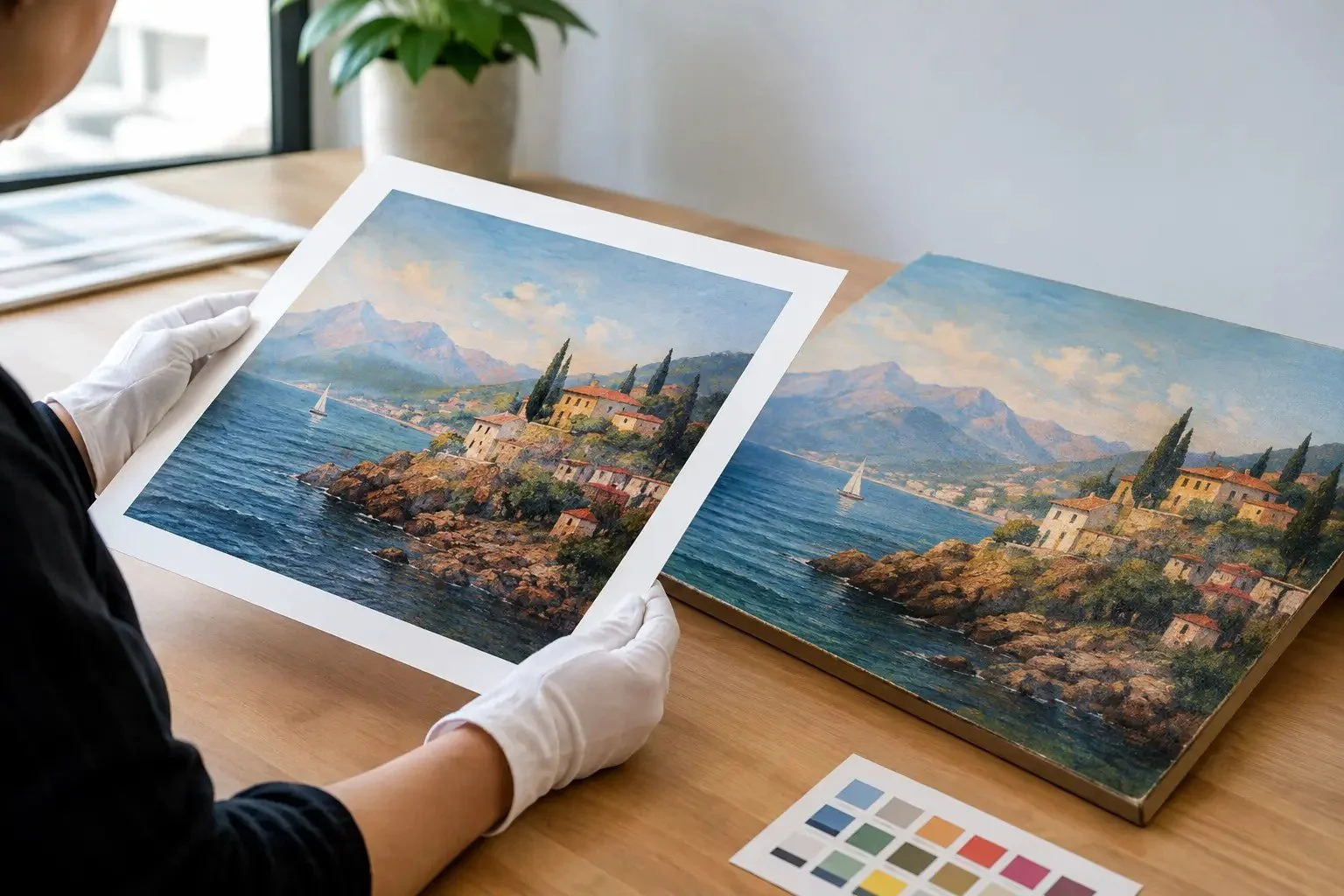
A print can carry an artwork into a catalogue, a collector's home, an archive or an edition offered years after the original leaves the studio. It can also flatten a subtle surface, shift a carefully chosen neutral or turn a deep black into something merely dark. Fine art print reproduction is therefore not about making an image look attractive. It is the disciplined work of making a printed object that stays accountable to the artwork.
For artists, galleries, museums and collectors in Malaysia, the standard should be clear: the print must preserve the artist's decisions as faithfully as its format and materials allow.
Fine art print reproduction begins with a faithful capture
No printer, paper or file format can recover information that was never accurately captured. Quality is set at the imaging stage, where scale, alignment, illumination, colour, texture and tonal range work as one system.
Uneven light creates false gradients across the surface.
Gloss can hide passages of paint.
Heavy texture can throw distracting shadows.
A slight colour cast becomes more obvious once the image is printed.
Professional artwork reproduction photography deals with these problems before the file reaches a printer. This matters most for restrained palettes, where a warm white, a near-black blue or a pale green-grey may be central to the artist's intent.
Resolution is necessary, not sufficient
A file needs enough detail for the print size, viewing distance and subject. Yet a high-resolution file can still make a poor print if the capture is soft, the colour is unmanaged or the editing ignores the original. Over-sharpening adds halos and makes delicate washes feel brittle.
A small catalogue image, a full-scale facsimile and a limited-edition giclee print each need a different file strategy, so decide the intended use early.
Colour management protects intent
Colour management connects the camera, monitor, software, printer, ink set and paper through known profiles and controlled viewing conditions. A calibrated monitor is essential, but the artwork remains the reference.
Ink on paper does not behave like light on a screen. Some pigments, fluorescent passages, metallic leaf and highly saturated colours fall outside what a print process can reproduce. The goal then is an informed translation that keeps the visual hierarchy of the artwork, for example preserving a blue's value and its relationship to neighbouring colours when its full saturation cannot be matched.
Paper is part of the reproduction
Paper affects density, contrast, surface character and perceived sharpness.
Matte papers soften reflected light and often suit charcoal, pastel, watercolour and painterly work.
Gloss and lustre papers deepen blacks and heighten apparent detail, but can add reflections.
Archival pigment inks on acid-free, lignin-free papers are a common choice for fine art editions.
There is no universally correct paper. Choose in relation to the original medium, the character of the work and where the print will be displayed.
Proofing is where assumptions become visible
A screen proof is useful, but it cannot replace a physical proof viewed under controlled light, beside the artwork where possible. Check that:
Shadows keep their separation
Highlights are open rather than chalky
Neutral passages stay neutral
Crop, scale, edges and paper tone feel right
For editions, keep the approved proof with the file version, paper specification and print settings so later impressions match it.
Texture, gloss and dimensional work need special care
Brushwork, impasto, varnish, graphite sheen, gold leaf and embossing all respond differently to light. A publication image may prioritise evenness, an archival record may add raking-light details, and a facsimile print may need methods that suggest texture without letting lighting artefacts become part of the image.
Presentation continues after printing
A faithful print can still be let down by how it is shown. Poor colour rendering shifts the look of paper and ink, while excessive intensity, ultraviolet exposure and heat contribute to fading. Reproduction and lighting are best considered together.
Frequently asked questions
What is fine art print reproduction?
It is the process of capturing an original artwork accurately and translating it into a colour-managed print that stays as faithful as possible to the original.
What is a giclee print?
It is a common term for a fine art inkjet print, typically made with pigment inks on archival paper or canvas.
Can any photograph of my artwork be used to make prints?
Only if it was captured with even light, accurate colour and enough resolution for the print size. Otherwise the print will reproduce the flaws of the photograph.
Start with an accurate capture from Nuray Lab
Nuray Lab provides high-resolution, colour-managed artwork reproduction photography in Malaysia, giving artists, galleries and collectors a dependable master file for print reproduction. To discuss your artwork, contact us.