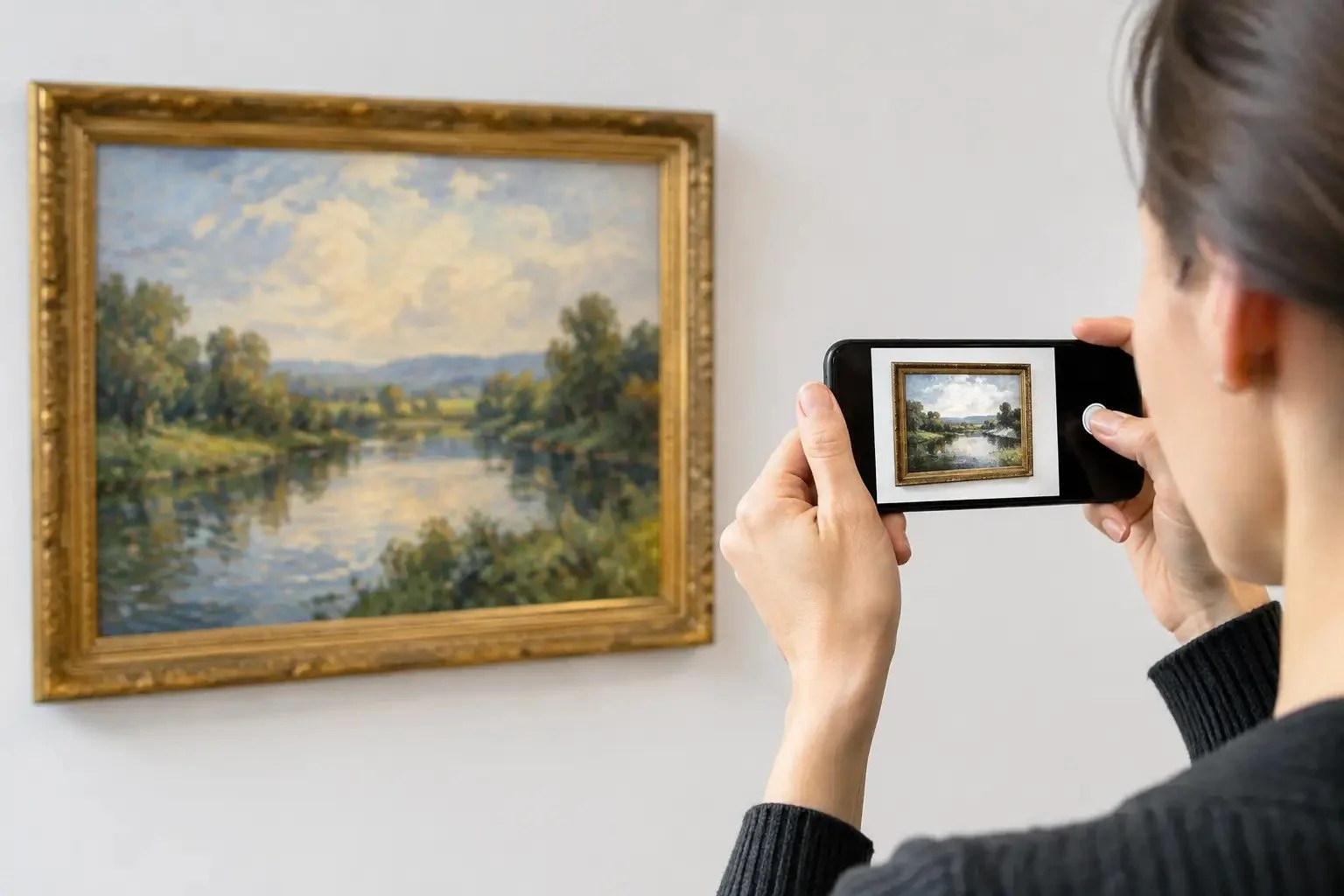
A painting can look resolved and alive in the studio, then appear flat, skewed or dull in a photograph. Why do paintings photograph poorly so often? Because a camera does not see a painting as the eye does. It records a narrow interpretation of reflected light, filtered through a lens, a sensor, a processing profile and finally a screen.
For artists, collectors, galleries and institutions in Malaysia, this is more than cosmetic. An inaccurate image can weaken a catalogue, misrepresent a work online, complicate insurance documentation or show a collector the wrong painting before they ever see the real one.
Why paintings are hard to photograph
Paintings hold colour, value, gloss, texture, scale and edge detail all at once, and each responds differently to light and camera settings. Fixing one often compromises another. Light placed to show raised paint may cause glare, softening it may hide texture, and a file corrected on a professional monitor may still shift on a phone. The goal is not drama but preserved relationships: colour balance, deep darks, delicate highlights and the character of the surface.
Surface finish changes everything
Gloss varnish, metallic pigments, resin, encaustic and some acrylic media create specular reflections that the camera records far more harshly than the eye. That is where white streaks, grey veils and reflections of the room come from. Moving the camera or lights can remove one reflection and create another, so the angles must be controlled. Our guide to reducing glare covers the same geometry for display.
Matte surfaces have the opposite problem. They avoid glare, but subtle texture and tone can disappear under overly diffuse light, leaving a lifeless image.
Texture depends on directional light
Impasto, brushwork, craquelure and relief are read through shadow and highlight. Broad frontal light flattens them; strong raking light exaggerates every ridge. Professional reproduction often separates the jobs: one controlled setup for the main colour record, plus detail or raking light images for texture and condition.
Light can distort colour before the camera does
Warm lamps push whites towards yellow and mute cool passages.
Incomplete spectra render some reds, violets, cyans and neutrals poorly.
Mixed light from a window and a room lamp puts two colour temperatures on one canvas.
Uneven light creates brightness gradients that are not in the painting.
The camera is not neutral
Phone cameras are built for quick, pleasing pictures. They brighten shadows, boost saturation, sharpen edges and merge exposures without telling you. That flatters a holiday photo but misrepresents a painting. Faithful reproduction uses controlled exposure, a colour target and a calibrated workflow, explained in our guide to artwork colour calibration.
Frequently asked questions
Why does my painting look different in photos?
Glare, uneven or mixed lighting, automatic camera processing and uncalibrated screens all change how colour and texture appear.
Can I photograph paintings with a phone?
For quick reference, yes. For catalogues, prints, sales or insurance, use a controlled setup and calibrated workflow.
How do I stop glare when photographing a varnished painting?
Control the angles of the lights relative to the camera, and use polarisation where appropriate. It takes testing for each surface.
Professional painting photography from Nuray Lab
A faithful photograph lets people meet the real painting, even from a screen. Learn about Nuray Lab's artwork reproduction service, or contact us to photograph your paintings in Malaysia.