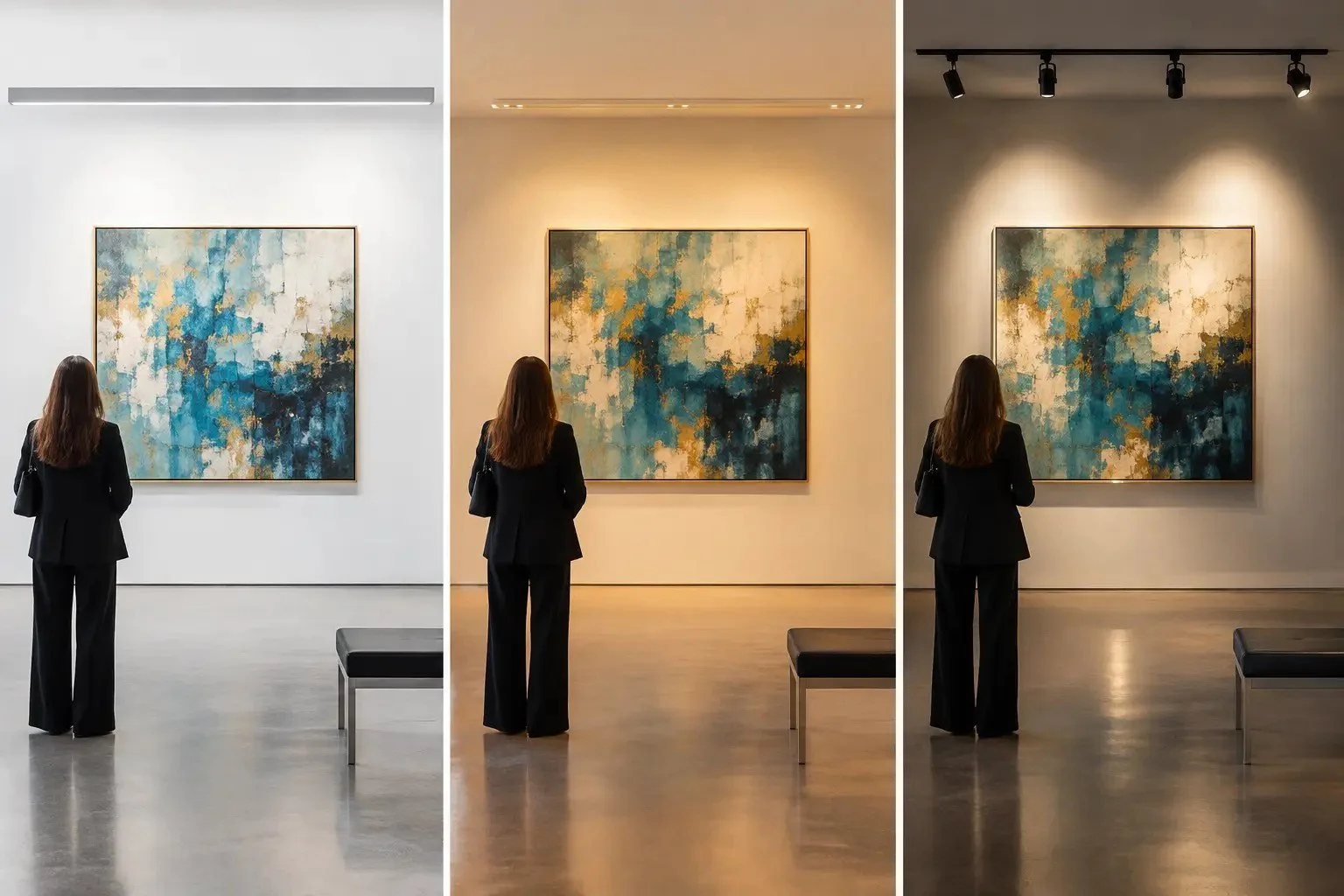
A serious art lighting comparison starts at the surface of the work, not at the fixture. A painting's warm underlayers, the relief of impasto, the quiet graphite of a drawing or the depth of a photograph all change under poor light. The right system preserves the artist's visual intention and gives viewers a reliable encounter with the work.
For galleries and private collections in Malaysia, lighting is a decision about colour, conservation, atmosphere and control. The best answer is rarely the brightest fixture or the highest number on a datasheet.
What should you compare?
Wattage, fixture size or a single colour rendering score can mislead. Museum-grade lighting is a system, judged on five connected criteria:
Colour quality: do pigments, papers and finishes look credible?
Beam control: does light reach the work without spilling onto walls, frames or glazing?
Dimming: can the level be tuned smoothly to each piece and room?
Conservation impact: ultraviolet, infrared, heat and cumulative exposure.
Visual comfort: no glare, hotspots or visible sources.
LED: precise, efficient and highly variable
Professional LED is now the standard for galleries, museums and collectors: low energy use, long life, little forward heat, refined dimming and optical control that older systems could not match. But LED is not automatically museum grade. A cheap LED can tint whites green, flatten reds or shift colour when dimmed, even with an acceptable CRI on paper.
Look beyond CRI. Values in the 90s are useful, but fidelity and gamut measures give a fuller picture of saturated reds, deep blues, skin tones and subtle neutrals. The practical test is visual: does the light reveal the work without adding a cast of its own? A good fixture also offers selectable beam angles, unit-to-unit consistency and stable dimming. See museum LED lighting for what to specify.
Halogen: familiar colour, real compromises
Halogen is valued for its continuous spectrum and warmth, and when well aimed it can render oils, wood and some sculpture beautifully. The costs are heat, higher energy use, short lamp life, and ultraviolet and infrared that need careful filtering and distance. For collections with light-sensitive work or long opening hours, those are hard to justify. Halogen can still suit a historic interior or a deliberate preference, but it should be chosen on purpose, not by default.
Fluorescent and standard retail lighting
Fluorescent and general retail lighting can provide cheap ambient light, but they are rarely suitable as primary display lighting for art. Colour quality, directional control, dimming and overall character usually fall short of what artwork needs.
Making the decision
Compare fixtures side by side on representative works, at the real mounting angle and light level, from where visitors stand. Check colour across reds, blues and neutrals, look for spill and glare, dim each fixture through its range and confirm the conservation data. Our guides on colour temperature and UV free LED art lights help with the details.
Frequently asked questions
Is LED better than halogen for art?
For most galleries and collections, yes: well-specified LED gives good colour with far less heat, UV and energy use. Quality varies widely, though.
Is a high CRI enough when comparing art lights?
No. It is a useful baseline, but test colour on real artwork and check fidelity and gamut data where available.
Can fluorescent lights be used for artwork?
Rarely as display lighting. They lack the colour quality and control artwork needs.
Art lighting from Nuray Lab
The right comparison ends with light that serves the work, not the specification sheet. Explore Nuray Lab's art lighting and products, or contact us to compare options for your gallery or collection in Malaysia.